 Mangystau Tours
What to Pack for a Mangystau Tour
What to pack for Mangystau is shorter than most desert packing lists sound, because the tours provide full board, camping gear on the multi-day trips and all the site permits. What is on you is dust protection, a warm layer for camp, cash in tenge and closed shoes for chalk and salt crust. The local hook worth knowing before you pack anything: once you leave Aktau there are no shops on the route, so anything forgotten stays forgotten.
Quick answer
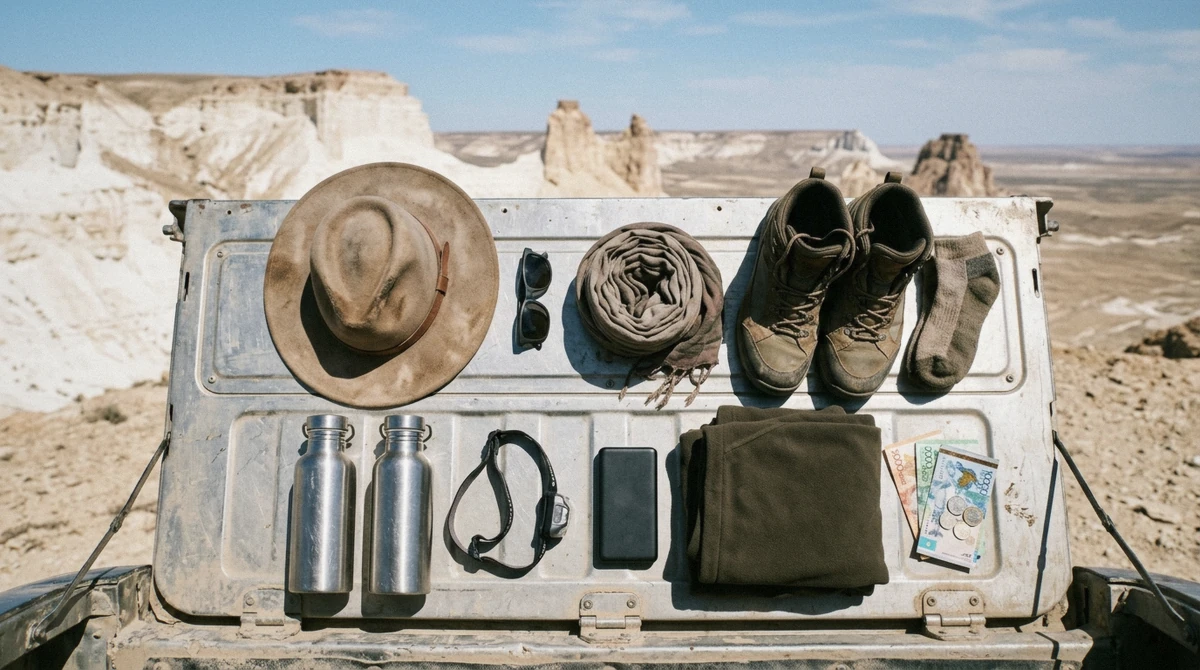
Tours provide full board, all site permits and, on the multi-day trips, tents and sleeping gear. What is on you is short: closed sturdy shoes, sun protection, a warm layer for camp, dust protection for cameras and phones, and cash in tenge, since nothing can be bought once you leave Aktau. Nights cool fast even in summer, and there is no shelter from the wind at camp.
Key takeaways
- Tours provide meals and, on multi-day trips, sleeping bags and mats, which is what the tours already include in full
- The bring list is short: closed shoes, sun protection, a power bank, cash and dust protection for cameras
- Do not bring flip-flops or heels as your main footwear, they have no grip on chalk, salt crust or loose rock
- Water: tours state 1 litre per person per day; there are no shops after Aktau to buy more
- Closed sturdy shoes are the footwear answer for every itinerary here, camp sandals are for evenings only
- Summer nights still drop fast once the wind picks up at camp, so pack a warm layer regardless of the season
What to Wear
Layers, not one outfit
Mangystau is a sharply continental desert: hot bright days, fast-cooling nights and sudden wind, plus dust that works its way into cameras, phones and bags. Layered clothing is the answer to all three at once, since the same shirt that works at midday will not be enough two hours after sunset.
Carry a warm layer for camp even in summer. There is no shelter from the wind once you are out on the plateau, and camp evenings consistently feel colder than the daytime city weather would suggest.
Sun protection
High-SPF sunscreen, sunglasses and lip balm are on the regional guide's core list, and for good reason: there is little shade for hours at a stretch on most of these itineraries, and the wind dries out lips and skin faster than a still climate would.
Footwear
Closed sturdy shoes are the answer here, not a preference. The terrain moves between chalk, salt crust and loose rock within the same day, and open shoes offer no grip on any of it. Bring camp sandals as a second pair for evenings only, never as the shoe you walk the sites in.
Sneakers with real tread are fine for the walking and the boat-deck-style approaches at the viewpoints; flip-flops, heels and unsecured sandals are not suitable for the activity itself, since the risk is losing them on loose rock or cutting a foot on the salt crust.
| Color | Good? | Why |
|---|---|---|
| White | Good | Reflects heat on hot days, though it shows dust fastest of any color out here |
| Black | Avoid by day | Absorbs heat under direct sun; fine after dark at camp when warmth is the goal |
| Earth tones (tan, olive, rust) | Good | Blends with the chalk and clay terrain and photographs cleaner in the dust |
| Bright or light colors | Fine | No wildlife-shyness issue here; light shades run cooler than dark ones in direct sun |
| Cotton | Avoid | Stays wet and cold once you sweat or get caught by wind, and dries slowly at camp |
| Quick-dry synthetic | Good | Handles the temperature swing between hot days and fast-cooling nights better than cotton |
What to Bring
The short list, item by item
This is what the tours do not hand you. Each item earns its place in the bag for a specific reason, not because a generic desert list says so.
- Layered clothing, warm layer included: hot days cool fast once the sun drops
- Warm layer for camp: no shelter from the wind after dark, even in summer
- High-SPF sun protection: hours with little shade on most itineraries
- Sunglasses: bright glare off chalk and salt crust
- Lip balm: dry desert wind chaps lips quickly
- Closed sturdy shoes: chalk, salt crust and loose rock underfoot
- Camp sandals, second pair only: for the evening, not for walking the sites
- Dust protection for cameras and phones: fine dust works into everything out here
- Power bank and cables: no outlets once you leave Aktau
- Headlamp: camps sit far from any ambient light
- Wet wipes: showers are generally not available on camping itineraries
- Personal medicine and a basic first aid kit: the nearest pharmacy is back in Aktau
- Offline maps and documents: mobile signal works in towns only, the six-day Mangystau tour with accommodation and meals excepted
- Cash in tenge: nothing to pay by card once you are on the road
What the Tours Already Provide
The table below is built from the actual inclusions listed on the six tours we compare, not a generic assumption about what a desert trip should include.
| Item | Usually provided | Bring your own | Notes |
|---|---|---|---|
| Water | 1 litre per person per day, stated on the listings | Extra water; a desert touring day needs more than the stated allowance | Buy more in Aktau before you leave, there is nowhere to buy it after |
| Meals | Full board on multi-day trips, hot lunch on the day trip | Personal snacks if you have specific dietary needs | All six listings include meals on the route |
| Sleeping bag and mat | Stated explicitly on the 6-day tour | Your own bag on the other multi-day trips, where it is not spelled out | Ask before assuming, coverage differs by listing |
| Tent | Camping equipment on the multi-day trips that camp, including the 3-day jeep tour | Nothing, camping gear is the operator's responsibility on these listings | Two nights of tent camping on the 3-day itinerary |
| Sun protection | Not included on any listing | Sunscreen, hat, sunglasses | None of the six lists sunscreen as included |
| Power | Not included as a standard amenity | Power bank and cables | Only the 6-day tour carries a vehicle refrigerator, not a general charging point |
| Internet | Starlink at camp on the 6-day tour only | Assume no signal on every other listing | Mobile coverage otherwise works in towns only |
| First aid | Mandatory travel insurance included on some listings | Personal medicine and a basic kit | Insurance is not the same thing as a first-aid kit riding in the vehicle |
| Cash | Not provided | Cash in tenge for tips and roadside stops | Card machines do not exist once you leave Aktau |
| Headlamp | Not provided | Your own headlamp | Camps sit far from any ambient light source |
What Not to Bring
A short list, drawn from the same operator listings and traveller reports as everything above.
- Cotton-only clothing: stays wet and cold once you sweat or the wind catches you
- Flip-flops or heels as your main shoe: no grip on chalk, salt crust or loose rock
- A hard-shell suitcase: 4x4s pack duffel bags and soft luggage far better than a rigid case
- Jewelry or anything you would hate to lose or damage: the days involve climbing over rock and travertine
- Any expectation of a signal outside a town: mobile coverage works in towns only, the six-day Mangystau tour with accommodation and meals excepted
- Any plan to buy something you forgot: there are no shops once you leave Aktau
Packing by Season
Spring (March to May)
Daytime 20 to 30 C, nights 10 to 15 C, with light rain on about 1 to 2 days a month. A light rain layer earns its space in the bag for this window in particular, alongside the standard warm layer for camp.
Summer (June to August)
Daytime often above 40 C, nights near 30 C. Sun protection matters most here, and the warm camp layer still earns its place: nights do not stay hot just because the day was.
Autumn (September to November)
About 25 C in September falling toward 10 C by November, with wind picking up through the season. A proper windbreaker matters more in autumn than in any other window.
Winter (December to February)
Daytime 5 to 10 C, nights about minus 5 C, snow especially in January. This is the one season where the warm layer stops being optional and becomes the whole packing list. Full month-by-month conditions covers what each season means for the trip itself, not only the bag.
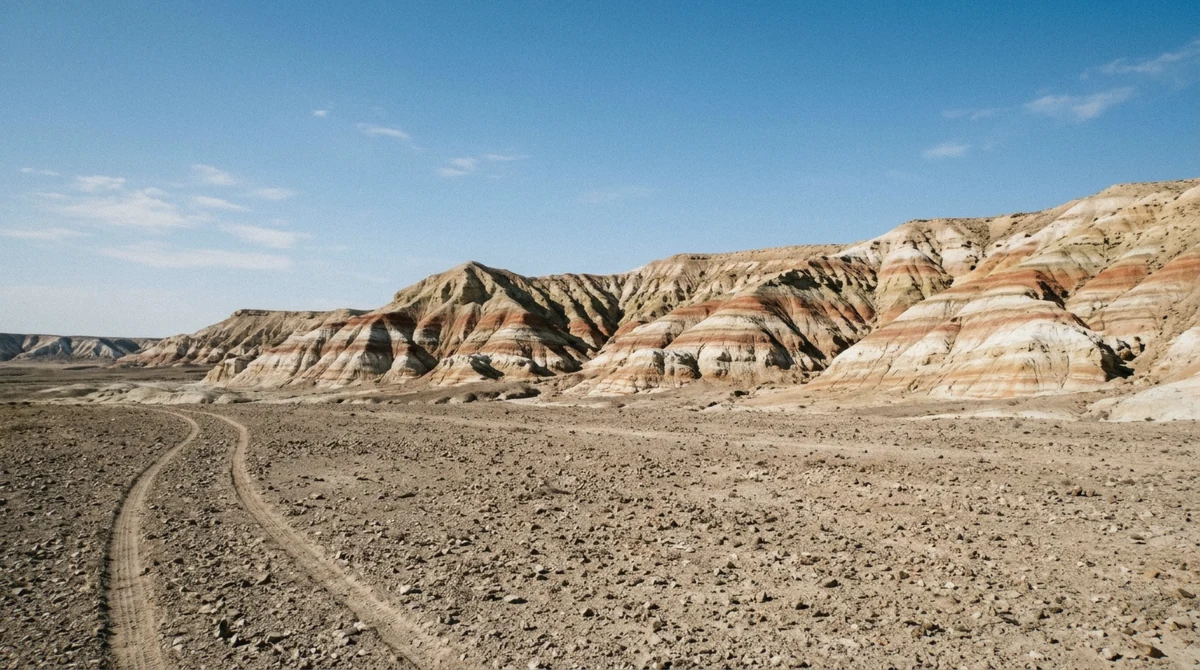
Kyzylkup, nicknamed Tiramisu for its striped layers. The dust here is fine and pale, the reason a lens cloth and a dust-proof bag earn their place on the checklist above.
What to Pack, by Travel Style
If you are on the 12-hour day trip and back in a hotel bed by night
skip the sleeping bag question entirely, but still carry the warm layer for the last stop at Airakty in low light
If you are camping two nights on the 3-day jeep tour
confirm bedding with the operator directly, since the listing does not spell it out the way the 6-day tour does
If you are travelling in winter
treat the warm layer as the priority item, not an afterthought, given nights near minus 5 C with wind
If you shoot photographs at every stop
prioritise the dust-proof bag and a lens cloth over anything else on the checklist
Dress Code at the Sacred Sites
Shakpak-Ata, on the day trip and several multi-day itineraries, is one of 362 sacred sites in the region and still an active place of pilgrimage, not a viewpoint with a car park. The published rule: men in long trousers, women in long trousers or a long skirt with the head covered by a scarf. Photography is restricted inside some of the underground chambers, so ask before the camera comes out.
Pack the scarf and the trousers regardless of the forecast. Getting to Aktau and out to the sites is covered separately in how to get to Mangystau, and this dress code applies the moment you arrive at the mosque, not just on a hot day.
Packing Questions
Can I wear jeans on a Mangystau tour?
Not a good idea. Jeans do not dry once they get dusty or damp, they restrict movement getting in and out of a 4x4 repeatedly, and they chafe if you sweat through a hot afternoon. Quick-dry synthetic trousers do the same job better.
Can I wear shorts?
Yes, for most of the day, in quick-dry material rather than cotton. The exception is Shakpak-Ata and the other sacred sites, where the dress code calls for long trousers on men and long trousers or a long skirt on women, regardless of the temperature.
Will I have phone signal to navigate once I leave Aktau?
No, outside of towns. Mobile coverage works in towns only, with the exception of the 6-day tour, which carries its own Starlink connection. Download offline maps before you leave Aktau.
Is there anywhere to buy sunscreen or a forgotten item once we leave Aktau?
No. There are no shops on the route once you are past the city, which is the reason the checklist above exists. Buy anything you might need in Aktau before departure.
Do the tours provide sleeping bags on the camping nights?
It depends on the listing. The 6-day tour states sleeping bags and mats explicitly. The other camping itineraries include tents and camping equipment but do not all spell out bedding the same way, so confirm with the operator before assuming.
What should I actually wear at Shakpak-Ata?
Long trousers for men; long trousers or a long skirt with the head covered by a scarf for women, as the operator publishes for this stop. It is an active pilgrimage site, so the rule applies whatever the temperature is doing that day.
The pattern across every listing is the same: the tours carry the heavy gear, the food and the water allowance, and travelers carry the small personal items that make the day comfortable. Pack for dust and a cold camp evening more than for a conventional desert heat wave, and the list stays short.